


Our solutions
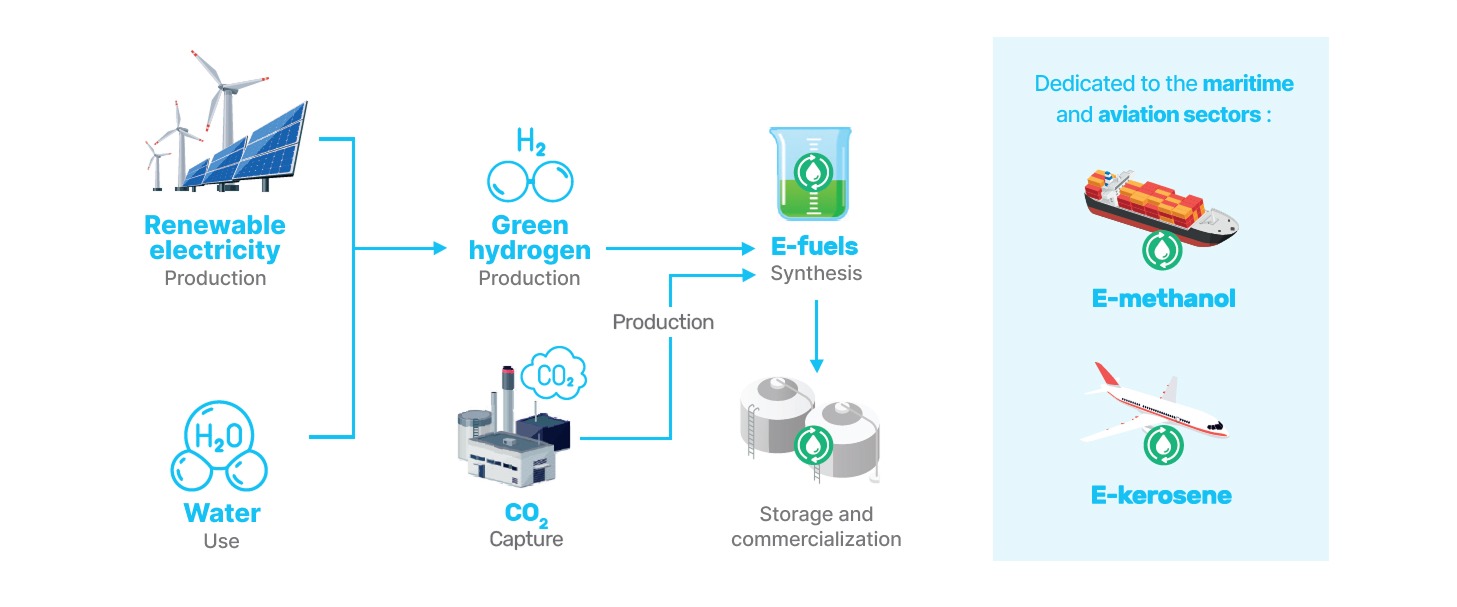
Synthetic fuels for low-carbon transport
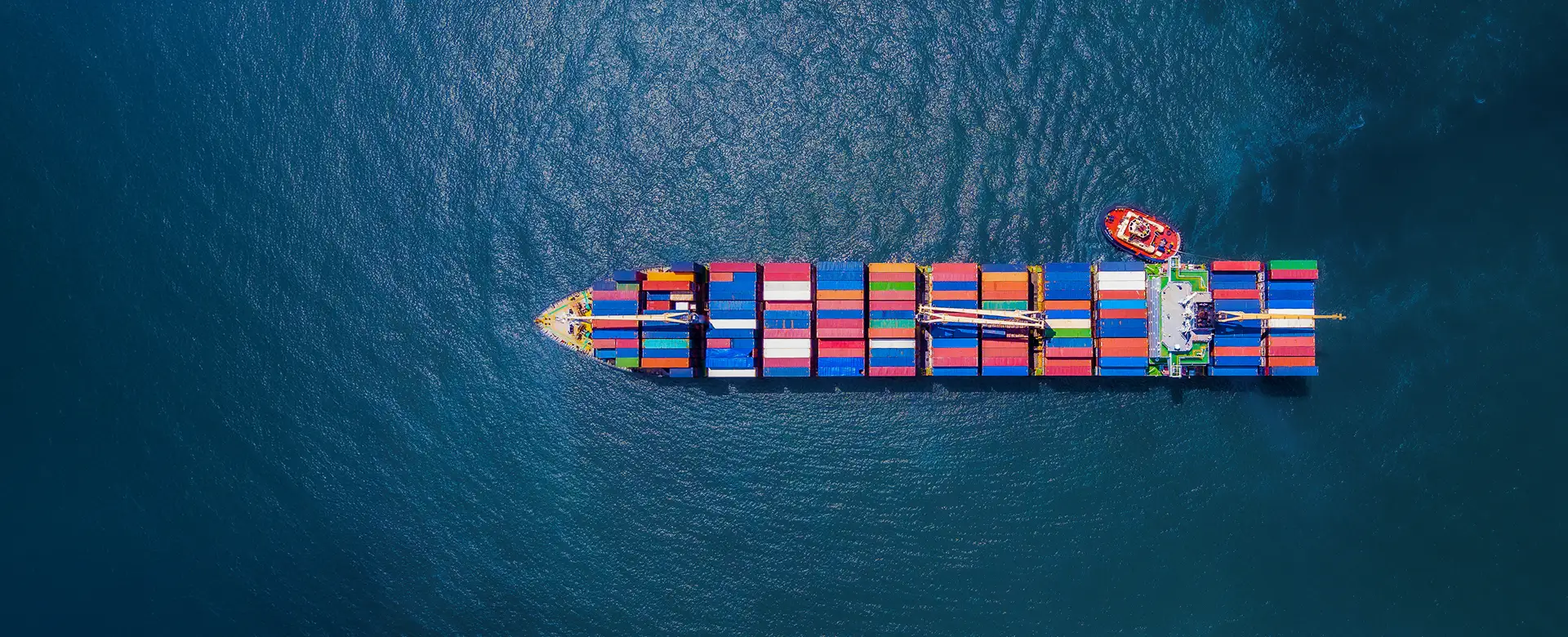
By recycling the CO2 present in the air or in the smoke, this new generation of fuels makes it possible to avoid the bulk of greenhouse gas emissions. Some 27,000 aircraft and 90,000 ships around the world are set to use these low-carbon fuels, such as e-methanol and e-kerosene, as future substitutes for fossil fuels.
Industry
Clean Firm Power, off-grid, for low-carbon industry and digital infrastructure
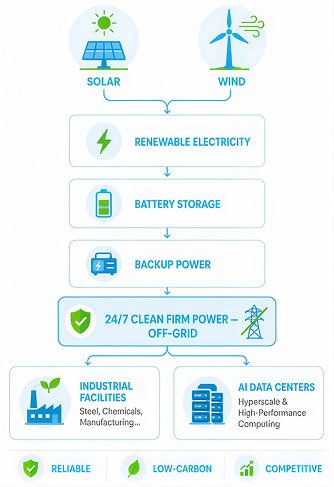
By combining renewable electricity production, energy storage and backup systems, Clean Firm Power makes it possible to deliver reliable low-carbon power 24 hours a day, 365 days a year — entirely off-grid.
This is a critical distinction: unlike conventional renewable energy solutions that still depend on the public grid, out-of-grid Firm Power draws nothing from it.
Out-of-grid Clean Firm Power offers a direct answer to this challenge: by generating, storing and securing power independently of the grid, it allows industrial facilities and hyperscale AI data centers to operate reliably without adding strain to public infrastructure.
Our sectors
Our projects
Project Janassim: an E-Fuel Production Plant in Morocco
As part of the Morocco Green Hydrogen Offer published in March 2024, our subsidiary MGH Energy Maroc is leading the ambitious Janassim project to develop, build and operate a plant to produce renewable synthetic fuels in the Dakhla-Oued Ed-Dahab region. As a player in the decarbonisation of maritime and air transport, MGH Energy Maroc intends to contribute to the emergence of sustainable energy sovereignty in the Kingdom. In addition to the Janassim plant, the company's project is part of an integrated approach that includes the development of associated industrial activities, the introduction of training and specialised diplomas tailored to emerging needs, and the deployment of initiatives to support agriculture and the local economy.
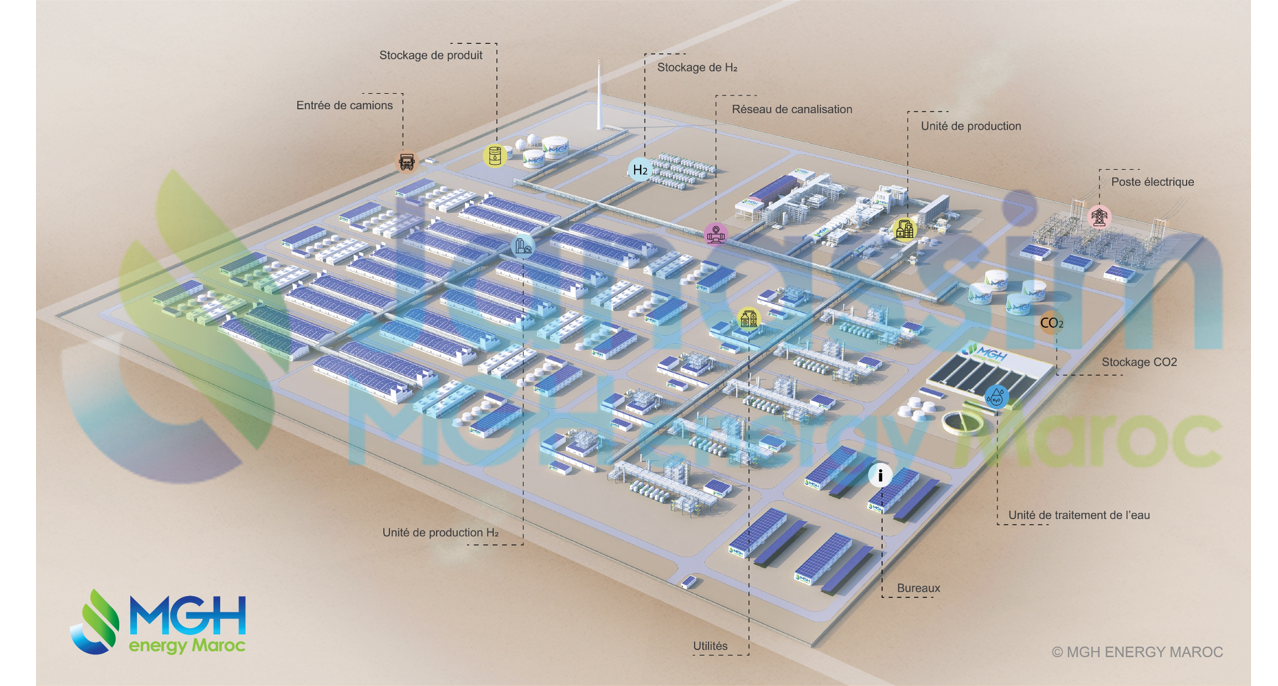
Janassim in figures:
- Nearly 500,000 tonnes/year of renewable fuels (e-methanol and e-jet)
- 2.2 GW of renewable energy (wind and photovoltaic)
- 50 billion Moroccan dirhams of investment
- 2,600 jobs created over 30 years of operation
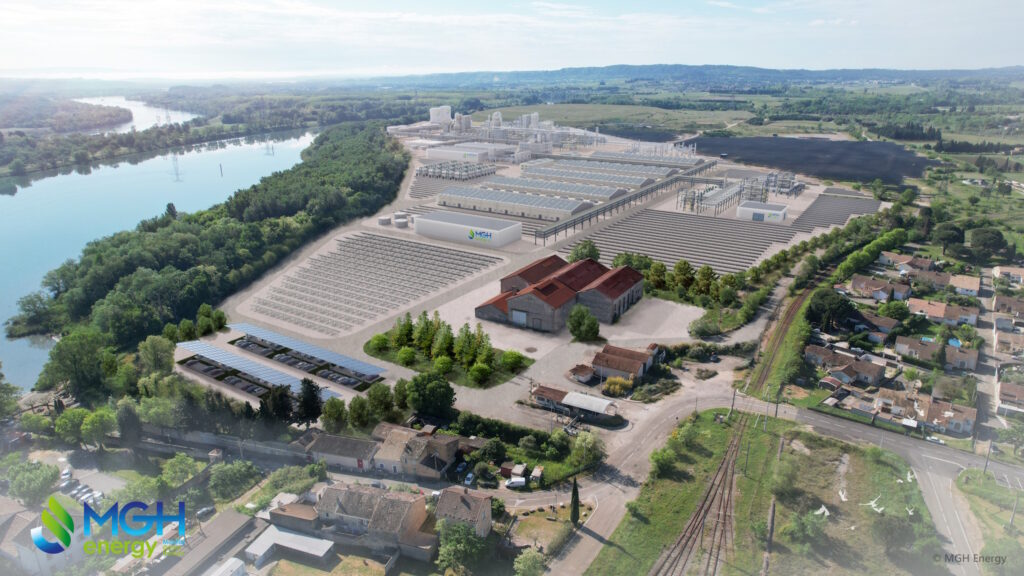
L'Ardoise in figures :
- Location: Laudun-l'Ardoise (Gard)
- Target production: up to 70,000 tonnes/year of e-kerosene and 50,000 tonnes/year of e-methanol from 2031.
- Investment: €1 billion
- Jobs: 400 direct jobs during the construction phase (2028-2031) and 200 permanent jobs during operation
L'Ardoise project: a synthetic fuels production plant in France
On 10 February 2026, the Communauté d'Agglomération du Gard Rhodanien announced the selection of the synthetic fuels production project led by MGH Energy, as part of the conversion of the L'Ardoise industrial site (Laudun-l'Ardoise). The aim of the project is to build a production unit for sustainable synthetic fuels to contribute to the decarbonisation of air (e-kerosene) and sea (e-methanol) transport. Industrial commissioning is scheduled for 2031.
Located on a plot of land that has been awarded the « turnkey site - France 2030 label », the project benefits from a strategic location and multimodal infrastructure (river, rail, pipeline) guaranteeing flexibility and logistical efficiency. Priority will be given to river transport, with barge transport via the Rhône and a connection to the Fos-sur-Mer axis.
member of: